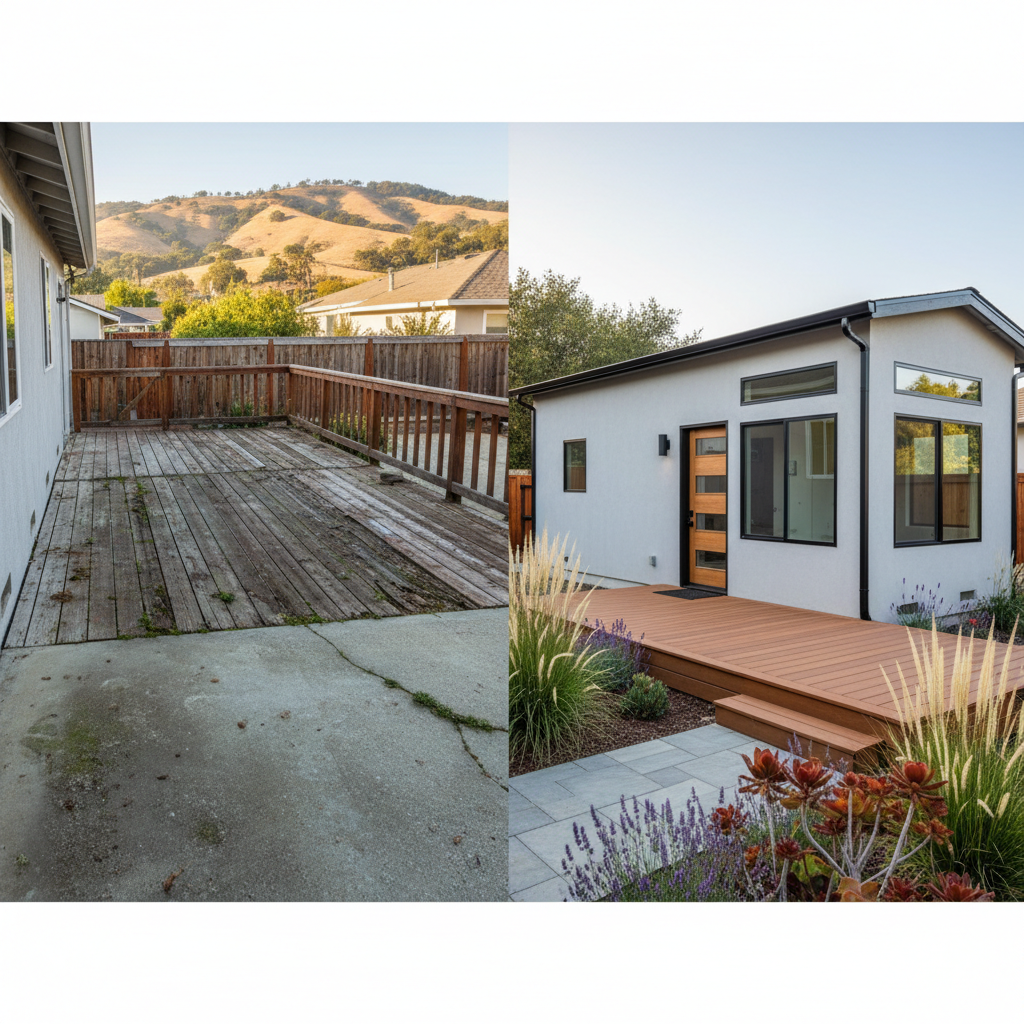
Alright, Pleasanton homeowners, let's talk about detached ADUs. So, you've decided you want that extra space in your backyard – maybe for family, maybe for some rental income – and you're thinking about building something completely separate from your main house. That's a smart move, truly; it gives you maximum flexibility and privacy. But once you start looking into it, you quickly realize there's more than one way to get this done. You've probably heard "prefab" versus "site-built," but "prefab" isn't just one thing, is it? Today, I want to compare two common approaches for detached ADUs that I see a lot of folks in Pleasanton weighing: traditional stick-built construction and panelized construction.
As a local contractor with Pleasanton ADU Solutions, I've worked with both methods. Each one has its own set of good points and bad points. It's not about one being inherently "better" than the other; it's about what works best for your specific property, your budget, and your timeline.
What's the Difference?
Let's get the definitions straight first, because these terms can get tossed around a bit. When I talk about a traditional stick-built ADU, I mean exactly what it sounds like: we build it from the ground up, piece by piece, right there in your backyard. Just like most homes you see going up, we frame it with individual lumber "sticks" on-site. Then we add everything else – sheathing, roofing, plumbing, electrical, finishes – all on your property.
Panelized construction, on the other hand, is a type of prefabrication. Instead of building the whole structure in a factory and shipping it (that's modular construction, a totally different animal), with panelized, the wall, floor, and roof panels are made off-site in a controlled environment. These large, pre-cut sections then get delivered to your property and assembled on your prepared foundation. Think of it like a very precise, large-scale LEGO set for your ADU, if you will.
Cost: Where Does Your Money Go?
This is usually the first question everyone asks, and it's a good one. For a detached ADU in California, costs can range quite a bit, but here's how these two generally stack up:
- Traditional Stick-Built: You're looking at roughly $200,000 to $400,000+ for a stick-built ADU. That depends on its size, the finishes you pick, and how tricky the site conditions are. The per-square-foot cost can be anywhere from $250-$400. Some might see it as more expensive upfront, but remember this method offers maximum customization. That can sometimes drive costs up if you're not careful with your choices.
- Panelized Construction: Panelized ADUs often fall into the broader "prefab" cost range, which can be 15-25% more affordable than traditional construction for similar quality. Some sources even suggest panelized construction can cut costs by up to 5% compared to stick-built. The savings primarily come from needing less on-site labor and creating less waste. Factory labor can be more efficient, and they use materials more wisely. But don't forget to include site prep, the foundation, utility hookups, delivery, and crane installation – these "soft costs" are always part of the equation, no matter how you build.
So, if budget is your absolute top priority and you're okay with a slightly less custom design, panelized might save you some money. But for a truly unique design, stick-built gives you more say over where every dollar goes.
Durability & Maintenance: Built to Last in California
Both methods, when done right and following California building codes, create a sturdy structure.
- Traditional Stick-Built: These are built using time-tested methods and quality materials. They're designed to last for generations. You're getting a structure that's essentially identical to your main home in terms of how well it's built.
- Panelized Construction: Don't let the "factory-built" aspect make you think it's less durable. Often, that controlled factory environment can actually lead to higher precision and better quality control. Materials aren't exposed to weather during the initial build, and processes are standardized. In fact, some folks argue that modular and panelized units can be more durable because they're designed to handle transportation, which puts them through stresses a stick-built home never experiences until an earthquake hits.
Maintenance-wise, there's really no big difference between the two once they're built. It all comes down to the quality of the finishes and how well you take care of it, just like any other house.
Appearance & Customization: Your Vision, Your ADU
This is where the two methods really differ, and it's a big deal for many Pleasanton homeowners who want their ADU to complement their existing property.
- Traditional Stick-Built: This method offers practically unlimited design flexibility. You can customize everything – the floor plan, ceiling heights, window placement, exterior finishes, and architectural style – to perfectly match your main house or create a completely unique look. This is super important if you have a specific vision or if your lot has odd dimensions or challenges.
- Panelized Construction: While more flexible than fully modular units, panelized construction still works best with pre-designed floor plans. You'll have options for finishes and some layout changes, but true architectural customization is more limited. If making it blend seamlessly with your existing home's unique style is a high priority, stick-built usually makes that easier.
Timeline: How Fast Do You Need It?
Time is money, as they say, and sometimes you need that ADU up and running sooner rather than later.
- Traditional Stick-Built: These projects typically take longer, often 6-12 months from start to finish, including getting permits. Weather delays (even in sunny Pleasanton, we get our rainy season!), inspections, and subcontractor schedules can all stretch out the timeline.
- Panelized Construction: This is where panelized really shines. Because the panels are built off-site, that part of the construction isn't affected by weather. Site work (foundation, utilities) can happen at the same time as panel fabrication. This parallel process can significantly cut down on-site construction time, often by 2-3 weeks, and sometimes even shorten overall project timelines by 15-30% compared to stick-built.
Recommendation for Typical CA Conditions
Considering our unique California conditions, especially here in Pleasanton, I tend to lean towards a specific recommendation.
Pleasanton's soils, like much of the Tri-Valley, often include expansive clays. These soils expand when wet and contract when dry, which can be tough on foundations if you don't handle them properly. While both construction methods require a well-engineered foundation, the flexibility of traditional stick-built construction allows for easier adaptation to these site-specific challenges. You can design and build a foundation (whether it's a slab or a crawl space) that is perfectly tailored to your geotechnical report, with deep footings and proper drainage to handle our local soil conditions.
Also, many homes in Pleasanton have distinct architectural styles – everything from the older, charming homes near downtown to the more modern developments in areas like Ruby Hill. With a stick-built ADU, you have the freedom to make sure your new structure truly complements your existing home. That can significantly boost your property's value and curb appeal, you know? While panelized construction is getting better with customization, it still can't quite match the bespoke nature of a fully site-built unit. This matters for long-term value and how well the ADU integrates into your property's overall look.
Now, if you have a perfectly flat, easily accessible lot, a very tight timeline, and you're happy with a more standardized design, panelized construction is a strong contender. It's efficient and can be quicker. But for most Pleasanton homeowners, especially those dealing with our local soil quirks or wanting a truly integrated design, the flexibility and customizability of a traditional stick-built detached ADU often make it the more robust and, ultimately, more satisfying choice. It's an investment, after all, and you want it done right, tailored to your home and our local environment.
No matter which path you choose, getting a good contractor who understands Pleasanton's permitting process and building codes is key. We at Pleasanton ADU Solutions are always here to help you sort through these decisions and build an ADU that works for you.